

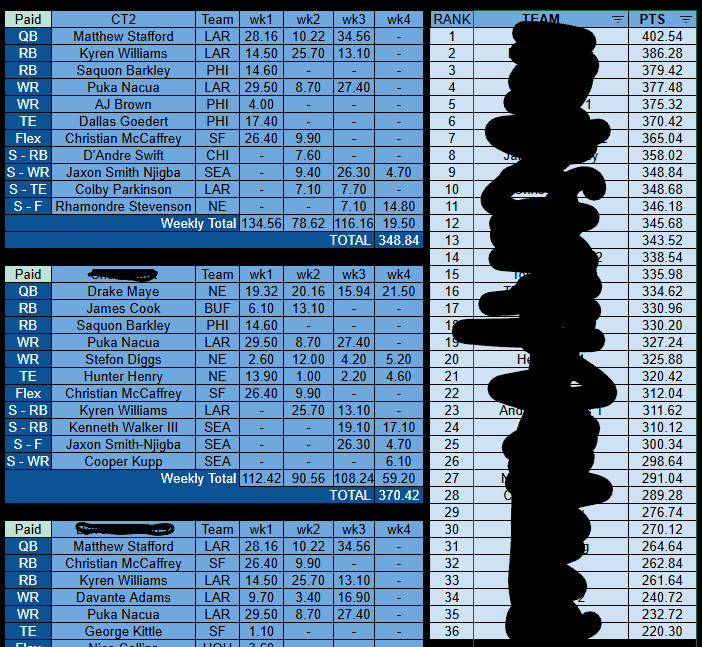
People email me their picks. I put them in a Google Sheet. Every week during the playoffs I manually look up every stat line for every player on every roster and update the numbers by hand. Then I announce standings in the group chat like a town crier reading from a scroll.
Six seasons of this. Six seasons of cross-referencing box scores at midnight on a Sunday, praying I don’t fat-finger someone’s receiving yards and start a controversy in the group chat.
The league rules aren’t complicated. They’re just specific enough that no fantasy platform supports them.
Here’s the format: you draft NFL playoff players. No bench. Just a starting lineup — QB, two RBs, two WRs, a TE, and a FLEX. Points are cumulative across the entire postseason. No head-to-head matchups. No weekly resets. Your guys score until they stop playing football.
When a player’s team gets eliminated, you get substitutions. Four of them. Total. For the whole playoffs. Use one because your receiver’s team lost in the wild card round, fine — but now you’ve only got three left. Use one voluntarily because you think you can upgrade at tight end? Bold move. Same cost.
There’s a pick deadline each round. PPR scoring with 2-point conversion math that requires subtracting out the receiving yards, rushing yards, and reception points that were already awarded — otherwise you’re double-counting. The kind of rules that make perfect sense when you’re explaining them over beers and make every fantasy app’s settings page completely useless.
So every January, I become a human spreadsheet. Collecting emails. Cross-referencing box scores. Copy-pasting stat lines into a Google Sheet and hoping I didn’t accidentally give someone else’s touchdown to the wrong guy.
This year I decided to stop doing that.
The Planning Conversation
Same workflow as WhoStat. Before I opened Claude Code, I sat in a regular Claude chat and talked through every rule, every edge case, every “wait, what happens when…” scenario.
Roster structure. Substitution logic. The scoring engine — which turned out to be the hardest part, because the 2-point conversion math has to actively undo the PPR and yardage points that were already awarded to avoid counting them twice. That’s not a setting you toggle. That’s custom logic that I’ve been doing in my head while staring at a spreadsheet at 11pm for six straight Januarys.
I walked through pick deadlines, the admin panel I’d need to enter scores, how the public standings page should work so people can stop texting me “what’s the score,” and what happens when someone burns all four subs by the divisional round.
Thirty minutes. Ten specific prompts covering project setup, data schema, the scoring engine, a query layer, public standings and team detail pages, an admin panel, business rule validation, API routes, and deployment.
Ten prompts. That’s the whole app that replaces six years of spreadsheet misery.
What It Actually Does Now
The site has a registration page where players pick their own seven-player roster and submit it themselves. No more emails. No more me manually typing “Josh Allen” into a cell at 1am because someone sent me their picks as a bulleted text message with no last names.
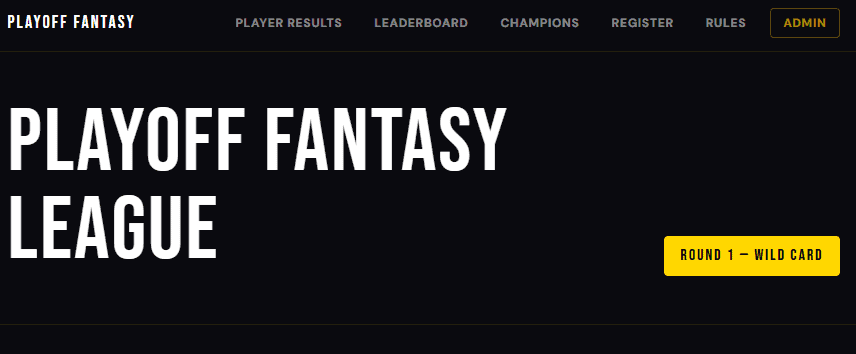
There’s a public leaderboard so everyone can check standings without texting the commissioner. A player results page showing how every drafted player is scoring across all rounds. An admin panel where I enter stats after each round — still manual, but now I’m entering them once into a real interface instead of hunting through a spreadsheet.
And the best part: a Hall of Champions page with every winner and runner-up since 2021. Gerard Balsamo sitting at two titles and three finals appearances like the dynasty he apparently is. The league’s history actually lives somewhere now instead of in scattered group chat memories.
Hosted on Railway. No database — just the app doing its thing. The commissioner still enters scores manually, but the site handles the math, the standings, the substitution tracking, and the public-facing everything.
The Build
Ten prompts, fed to Claude Code one at a time. The same approach that worked for WhoStat — architect in chat, execute in Code.
The scoring engine was the most satisfying part to watch come together. The 2-point conversion logic is genuinely tricky: you have to calculate the base PPR and yardage points, then figure out what portion came on 2-point plays, then subtract that out so you’re only crediting the conversion bonus. I’ve been doing this math manually for years. Watching Claude Code turn it into actual working logic felt like handing off a chore I didn’t realize I hated.
The registration flow was the other big win. People can go to the site, see the available players, pick their seven slots, and submit. No account needed. The commissioner (me) reviews and confirms. That single feature eliminates half the emails I used to get every January.
Why This One’s Different
Most of my builds are absurd on purpose. A pants delivery service. A URL lengthener. A calculator about children and tug of war.
This one replaces a real process that’s been annoying me every January since 2021. No more collecting picks from email. No more manually looking up every stat line on ESPN. No more copy-pasting numbers into a Google Sheet at midnight and hoping I didn’t give someone else’s touchdown to the wrong guy.
The league members get a real site with live standings and a place to register their own teams. I get an admin panel instead of a spreadsheet. Everyone wins — especially me, because I won the whole league in 2024 and now there’s a permanent record of it on the internet.
Will I maintain it forever? The playoffs only last a month. Build it once, use it every January, tweak it if the rules change. That’s not bailing — that’s seasonal engineering.
Build status: Live
Cost: Hosted on Railway
Users: The same 36 guys who’ve been arguing about playoff fantasy since 2021
Bail risk: Low — unless I somehow lose my own league, in which case the site might experience unexpected downtime