

Build Log: tugofwarcalculator.com
It started, as most great ideas do, at work.
Someone asked the group how many 5th graders they thought they could beat in a fight. You know the question. Everyone has a number ready. Nobody’s embarrassed about it. The room got loud.
But then someone changed the scenario: okay, but what about tug of war?
And that’s actually a completely different problem. Hand-to-hand combat against a pack of 10-year-olds is a question of reach, reflexes, and how much you’re willing to commit to the bit. Tug of war is physics. It’s weight, friction, grip strength, and coordinated pulling force distributed across a rope. You’re not fighting the kids — you’re fighting math.
So naturally, I tried to research it.
The Research Phase (I Lasted About 20 Minutes)
I poked around looking for actual data on how much pulling force a 5th grader generates in a tug of war scenario. Turns out there isn’t a ton of peer-reviewed literature on this specific topic, which feels like a glaring gap in the academic community.
I found some general grip strength data. Some pediatric exercise physiology stuff. Nothing that translated cleanly into “here’s how many kids it takes to drag a 190-pound adult across a line.”
So I did what any reasonable person does when real research gets tedious: I opened Gemini and just asked it.
And here’s the thing — it actually worked. Gemini pulled together estimates on average grip strength by age, made reasonable assumptions about body weight and center of gravity, and handed me a working formula with actual numbers. Real enough to build something. Real enough to settle arguments.
I could’ve written it in a notes app and moved on with my life.
I did not do that.
From Math Problem to Website in One Conversation
Once Gemini gave me the numbers, I had it write the website.
That’s the whole build. One tool, one conversation. I asked it to code me a single-page calculator where you can plug in your own stats on one side and build a theoretical team of kids on the other side, and it spits out who wins on paper.
No frameworks. No database. No backend. Just a clean HTML page with the math baked in, doing exactly one thing.
The whole build took less time than the original workplace argument that inspired it.
I threw it up at tugofwarcalculator.com.
What the Tool Actually Does
You go to the site, enter your weight and general athletic disposition, and then configure a team of elementary schoolers to pull against you. The calculator estimates the combined pulling force of your theoretical kid-team against your own numbers and tells you how the matchup shakes out.
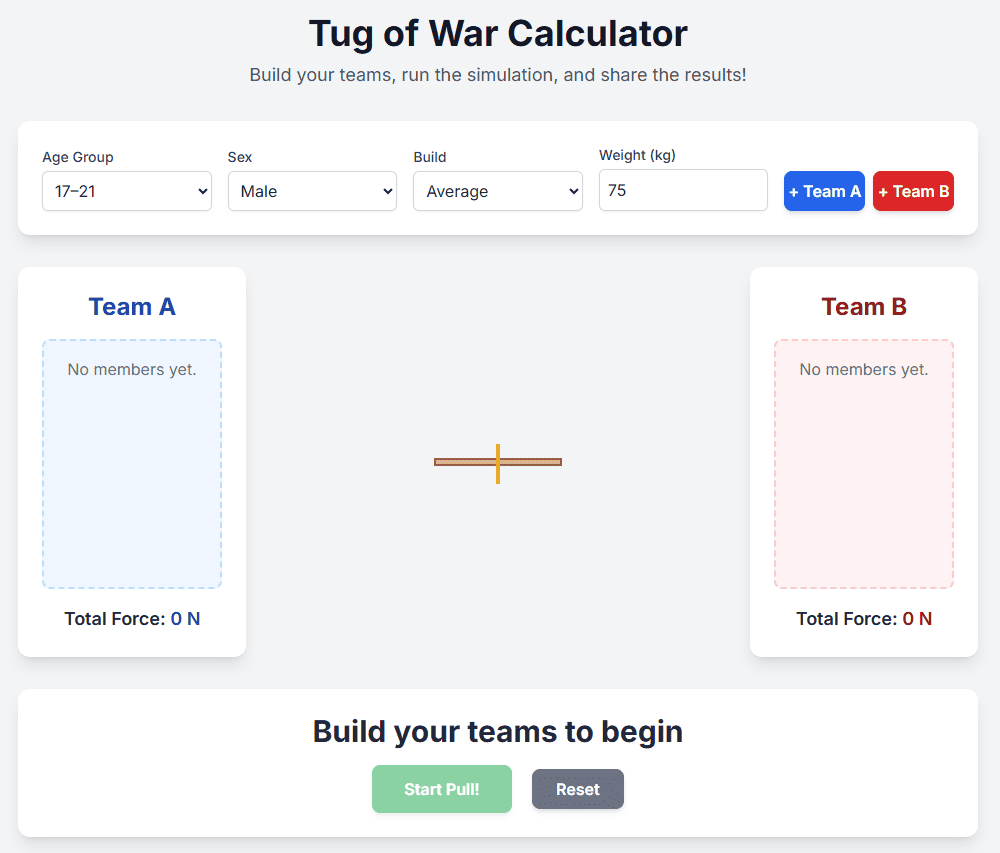
Is the math perfect? No. Is this medically, physically, or ethically sound advice? Also no. But is it directionally correct enough to end a workplace debate? That was the whole goal, and I think yes.
There’s also something kind of funny about the fact that a real academic paper I found on tug of war physics notes that on most surfaces, the sport essentially comes down to who’s heavier — not who’s stronger — because friction is what actually keeps you from sliding. So your grip strength barely matters. Your weight does. That’s either comforting or devastating depending on where you land on the scale.
What I Actually Learned
AI as a research shortcut is underrated. I wasn’t asking Gemini to make something up — I was asking it to synthesize publicly available data on pediatric exercise physiology into a usable estimate. That’s genuinely useful. That used to require either a science background or a lot of time I don’t have.
Scope is a superpower. The calculator does one thing. It doesn’t track your results over time or let you create an account or share your matchups or any of the other feature creep that turns a two-hour project into a two-month one. One page, one question, one answer.
The best tools are the ones people already want. Nobody asked me to build this. But the second I told people it existed, everyone went to try it. The question “how many kids could you beat in tug of war” is already living rent-free in people’s heads — I just gave it a home.
The Verdict
Built: Yes.
Time: A couple hours, including the original research spiral.
Abandoned: Technically. But it’s still up and it still works, so it’s more of a “parked” situation.
Would I do it again: Definitely.
The calculator lives at tugofwarcalculator.com. Go find out how many kids it takes to drag you across a line. The answer is probably fewer than you’d like.
-CT